How Millions of Hooves Shape Africa’s Most Famous Migration
- wildebeestsighting
- Jan 6
- 2 min read

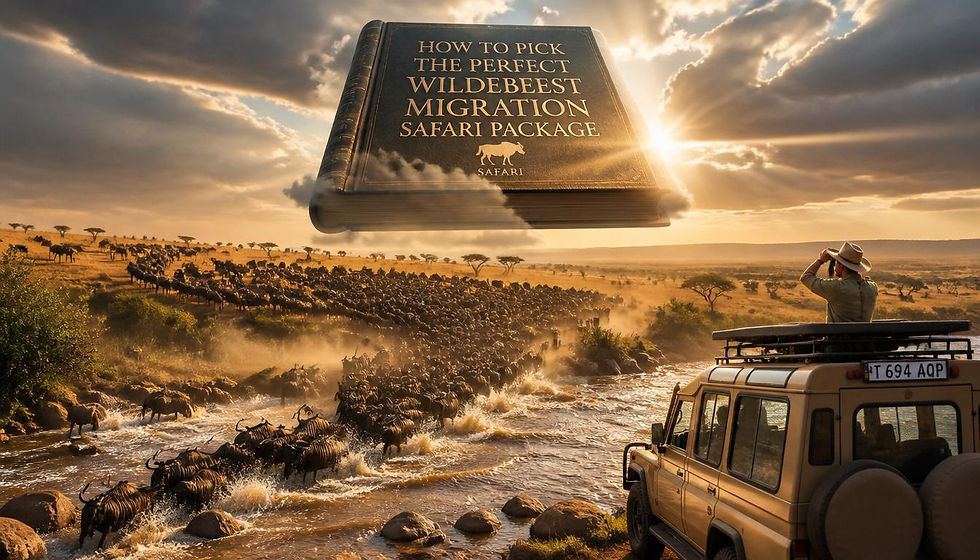
The great migration Africa is one of the most extraordinary wildlife events on the planet. Every year, the thunder of millions of hooves echoes across the savannas of East Africa as vast herds of wildebeest, zebras, and gazelles move in search of fresh grass and water. This natural phenomenon is not just a visual spectacle—it is a powerful ecological force that shapes landscapes, supports predators, and sustains entire ecosystems.

Understanding the Great Migration in Africa
At the heart of the great migration Africa lies a simple survival instinct: follow the rain. Seasonal rainfall patterns determine where grasses grow, and grazing animals instinctively move toward these nutrient-rich pastures. The migration primarily unfolds across Serengeti National Park in Tanzania and the Masai Mara National Reserve in Kenya, forming a continuous, circular journey rather than a single straight path.
More than 1.5 million wildebeest, alongside hundreds of thousands of zebras and gazelles, take part in this annual movement, making it the largest land-based animal migration on Earth.
How Millions of Hooves Shape the Landscape
As these massive herds move, they do more than simply graze. Millions of hooves naturally till the soil, helping seeds penetrate the ground and promoting new grass growth. Grazing prevents overgrowth, recycles nutrients back into the soil, and maintains the open grasslands that many African species depend on.
This constant movement also prevents environmental exhaustion. Without the migration, certain areas would be overgrazed while others would become choked with old, dry vegetation. In this way, the great migration Africa acts as a natural land-management system refined over thousands of years.
A Lifeline for Predators and Scavengers
The migration supports one of the richest predator populations in the world. Lions, cheetahs, leopards, crocodiles, and hyenas all rely on the predictable movement of herbivores for survival. River crossings—especially along the Mara River—are dramatic moments where predators test the strength of the herds.
Even in death, migrating animals contribute to the ecosystem. Carcasses provide food for vultures and other scavengers, while nutrients from remains enrich rivers and surrounding soil.
Seasonal Rhythm of the Migration
The great migration Africa is a year-round cycle rather than a single event. Calving season in the southern Serengeti brings thousands of newborns each day, attracting predators and offering unmatched wildlife viewing. As dry seasons arrive, herds move north toward greener pastures, eventually crossing into Kenya before looping back south when rains return.
This rhythm links climate, wildlife behavior, and geography into one continuous natural process.
Why the Great Migration Africa Matters
Beyond its beauty, the great migration Africa is vital for conservation and local economies. It supports biodiversity, maintains ecological balance, and fuels sustainable tourism that benefits surrounding communities. Protecting migration corridors ensures that this ancient journey continues for generations to come.
Final Thoughts
The great migration Africa is more than a wildlife event—it is nature in motion on a continental scale. Each hoofbeat contributes to a larger story of survival, balance, and renewal. For travelers, conservationists, and nature lovers alike, understanding how millions of hooves shape Africa’s most famous migration deepens appreciation for one of Earth’s greatest natural wonders.

Comments